She is beautiful, she is Catholic, she is the King's sister, she is Marguerite of Valois. Her brother calls her Margot. He is Protestant, they say that he is rude, that he never shaves, that he smells of garlic and sweat. He is Henri of Navarre. They are forced to marry. It is a political move : to reconcile the French, ripped apart by the Wars of religion. They are three brothers : the eldest, King Charles IX , Anjou and the youngest, Alençon. They love Margot, they love her too much, with an ambiguous and possessive passion. Yet they are all present, laughing, dancing, pretending to have fun. The head of the family is Catherine of Medicis. She has taught her children about hypocrisy and given them the taste for power. During this terribly hot month of August, hate and fear will drown everything else. Because it is not Charles IX who rules, but Madame Catherine, and she loves Anjou. She wishes to give him a kingdom at peace. How far will she go ? All the way.
Les grands classiques restaurés
44 filmsHéritage du grand écran
Re-discover masterpieces of French heritage cinema in restored version! From the 1920s to the 2000s, explore the history of French cinema through genres, eras, and great legendary figures: Agnès Varda, Maurice Pialat, Claude Chabrol, Robert Bresson, Marcel Carné, Claude Sautet, Costa Gavras, Patrice Chéreau, Arletty, Simone Signoret, Alain Delon, Jean Gabin, Jeanne Moreau, Isabelle Adjani...
This tragic tale centers around the ill-fated love between Baptiste, a theater mime, and Claire Reine, an actress and otherwise woman-about-town who calls herself Garance. Garance, in turn, is loved by three other men: Frederick, a pretentious actor; Lacenaire, a conniving thief; and Count Eduard of Monteray. The story is further complicated by Nathalie, an actress who is in love with Baptiste. Garance and Baptiste meet when Garance is falsely accused of stealing a man's watch. ..
The skipper of a Breton tugboat, a man of courage and duty, leads a hard and difficult life. His life is divided between his passion for his work and his love for his wife. During a salage of a cargo ship, he meets a woman who troubles him and with whom he leaves...
It's the start of the school year at a provincial college. Life resumes with heckling in the dormitory, traditional punishments, recess, hectic studies and conflicts with the administration. One evening, the residents decide to free themselves from the authority of the adults and start a revolt. Jean Vigo's most autobiographical work in its restored version.
Normandy: 1944. Albert vows never to drink again if he and his wife survive the war... The reformed alcoholic must now face the difficulty of keeping his promise. Soon after the war, Albert meets young Gabriel, a heavy drinker conflicted over reconciling with his young daughter. In order to help Gabriel out, Albert decides he must take off with him on one last nostalgic drinking binge. The result is madcap havoc...
Cherbourg, November 1957. Madame Emery and her daughter, Geneviève, run a store called The Umbrellas of Cherbourg. Geneviève is in love with Guy, a mechanic working in a garage. When her mother learns of the relationship, she disapproves. Guy live with his aunt, who is seriously ill. He is called to do his military service in Algeria. The two lovers must part. Pregnant and desperate because she has little news of Guy, Geneviève is forced by her mother to marry Roland Cassard, a rich wholesaler of precious stones. She leaves Cherbourg with her mother.
In France of the late 19th century, the wife of a wealthy general, the Countess Louise, sells the earrings her husband gave her on their wedding day to pay off debts; she claims to have lost them. Her husband quickly learns of the deceit, which is the beginning of many tragic misunderstandings, all involving the earrings, the general, the countess, & her new lover, the Italian Baron Donati.
A brilliant surgeon, Dr. Génessier, helped by his assistant Louise, kidnaps nice young women. He removes their faces and tries to graft them onto the head on his beloved daughter Christiane, whose face has been entirely spoiled in a car crash. All the experiments fail, and the victims die, but Génessier keeps trying.
Upon his release from prison, Mr. Charles finds his house and his wife who has been waiting for him with a few million. He wants to pull off one last job and leave for Australia. In the company of Francis, a young crook, and Louis, an honest garage owner, he leaves for Cannes. The trio has one goal: the Palm Beach recipe for the season...
The film follows Marie, a shy farm girl, and her beloved donkey Balthazar, through many years. As Marie grows up the pair become separated, but the film traces both their fates as they continue to live a parallel existence, continually taking abuse of all forms from the people they encounter. The donkey has several owners, most of whom exploit it, often with more cruelty than kindness. He bears his suffering with nobility and wisdom, becoming a saint in the process. In the end, both suffer often at the hands of the same people. They do differ, though, in that Marie's fate remains unclear, whereas the donkey's is clear.
An ordinary accident on a country road, a car driving at excessive speed, rolls over several times... The victim is a forty-year-old architect, Pierre, well-to-do, separated from his wife Catherine, with a grown son and a mistress Helene. He is at the age where one asks oneself questions. Ejected from the car, lying in the grass of the meadow, half conscious but already dying without knowing it. Pierre relives a few episodes from his past, rediscovering the sweetness of the "things of life", until the moment when, dreaming with his family, next to the family boat, he sinks without recourse into death.
Max is a Paris detective, aloof, independently wealthy, and frustrated by gangs of robbers whom he cannot catch. To re-establish his stature and save face, he decides to inveigle a group of petty thieves (led by an old acquaintance) to rob a bank. A reluctant captain provides Max intelligence and Max starts spending evenings with Lilly, a prostitute who's the girlfriend of the group's leader. He poses as a rich banker with money to burn and encourages Lilly to think about her future. He hints at a payroll that comes through his bank. The plot works, the petty thieves think they're ready for a big score, and the cops are in place. What could go wrong with Max's cold plan? Who's entrapped?
Rosalie is amicably divorced, dividing her time between her mother's house, with her siblings and small daughter, and César's. He's self made, a scrap iron king, outgoing, amiable, in love with her. Enter David, an artist and Rosalie's flame before her marriage. In a quiet, brooding way, he seeks to reclaim Rosalie. César's jealous outbursts and attempts at cunning backfire and send Rosalie into David's arms. César keeps trying: he buys Rosalie's childhood seaside vacation home as a gift, wins her back, then must ask David to join them so Rosalie will be happy. When Rosalie discovers César and David's complicity, she again asserts her freedom, leaving the men alone together.
Three friends face mid-life crises. Paul is a writer who's blocked. François has lost his ideals and practices medicine for the money; his wife grows distant, even hostile. The charming Vincent, everyone's favorite, faces bankruptcy, his mistress leaves him, and his wife, from whom he's separated, wants a divorce. The strains on the men begin to show particularly in François and Paul's friendship and in Vincent's health. A younger man, Jack, becomes attractive to Lucie, François's wife. Another young friend, the boxer Jean, who's like a son to Vincent and whose girlfriend is pregnant, has taken a bout with a merciless slugger. Has happiness eluded this circle of friends?
Miss Lewly boarded in Halifax in 1863. There she looked for Lieutenant Pinson, with whom she was madly in love but who did not love her. He may tell her, but she continues to pursue him even though she knows he has a mistress. Miss Lewly is actually Adèle Hugo, the poet's second daughter. She tries at all costs to marry him, making Pinson's marriage to another woman fail. Adele's mother dies, and Pinson goes to the Bearded One, she follows him. Gathered by Mrs. Baa, who warns the Hugo family, she will be sent back to France and interned.
In Thiers, in the Puy de Dôme, a handful of children live the last weeks of the school year waiting impatiently for the holidays: Bruno, Patrick, Laurent, Mathieu or Franck, without forgetting Martine... They all live at their own pace and give a soul to this village where the two teachers, Melle Petit and M. Richet, try as best they can to capture their attention as the summer camp approaches.
Dans l'appartement secret de Sa Majesté, un peintre met la dernière main au portrait du roi. Mais il a oublié de dessiner d'abord une cage. Et le portrait, qui est l'âme damnée du roi, supprime son modèle et prend sa place. Du coup, l'essence des choses se révèle, l'inexprimable peut s'exprimer. Le tableau représentant une bergère et un ramoneur s'anime. Ils s'avouent leur amour. Mais le roi est amoureux de la bergère, et les enfants qui s'aiment doivent se sauver... Scénario et dialogues de Jacques Prévert, d’après La Bergère et le Ramoneur de Hans Christian Andersen.
In late spring, 1890, Vincent moves to Auvers-sur-Oise, near Paris, under the care of Dr. Gachet, living in a humble inn. Fewer than 70 days later, Vincent dies from a self-inflicted gunshot wound. We see Vincent at work, painting landscapes and portraits. His brother Theo, wife Johanna, and their baby visit Auvers. Vincent is playful and charming, engaging the attentions of Gachet's daughter Marguerite (who's half Vincent's age), a young maid at the inn, Cathy a Parisian prostitute, and Johanna. Shortly before his death, Vincent visits Paris, quarrels with Theo, disparages his own art and accomplishments, dances at a brothel, and is warm then cold toward Marguerite.
1948. Clément Mathieu, an unemployed music teacher, finds a job as proctor in a correctional boarding school for minors. Although particularly harsh, the educational policies of the school's director, Rachin, are proving ineffectual. Clément sets out to change the pupils' lives by acquainting them with the magic and power of music.
Directed by Patrice Chéreau and filmed live from the Théâtre de L'Archevêché in Aix-en-Provence, this performance of Cosi fan Tutte is one of the lyrical events of recent years. Patrice Chéreau returns to opera and Mozart, with a brilliant cast - six singers including Ruggero Raimondi, under the baton of British conductor Daniel Harding. This is a version far from the usual Mozartian jubilation, which privileges the gravity of deception in a sober, even stripped-down, backstage theatre setting. It anchors Mozart's opera in an intense dramatization of the plot through the play of glances, mirrors and double plays that make theatre. This recording faithfully and precisely reproduces the meticulous work of Chéreau and the singers.
The kids from the "Bluebell" projects have spent all night warring with the police. Why ? Because a 16-year-old boy, Abdel Ichaha, is at near death after being beaten up under questioning by a police officer. Among these kids blinded by hate are three homeboys - Hubert, Saïd and Vinz. Together they're about to live the most important day of their lives. Because today there's the fourth hero of our story : the gleaming, chromeplated 9mm Beretta automatic which a plainclothes policeman is reported to have lost during the rioting.
Cleo, a young and pretty singer, waits for the results of medical tests. From superstition to fear, from the Rue de Rivoli to the Café du Dôme, from coquetry to anxiety, from her apartment to Parc Montsouris, Cleo lives through ninety peculiar minutes. Her lover, a musician accompanist, a female friend, and then a soldier open up her eyes to the world.
The film is a feminist musical. Two young girls live in Paris in 1962. Pauline (17), a student, dreams of leaving her family to become a singer. Suzanne (22) is taking care of her two children and is dealing with the drama of their father's suicide. Life separates them, each one living her own struggle as a woman. Pauline became a singer in a militant and itinerant group after having lived a difficult union in Iran. Suzanne is out of her misery and works at the Family Planning. Ten years later, they meet again during a feminist demonstration. At the end of this chronicle, we find them together again, with their children who have grown up.
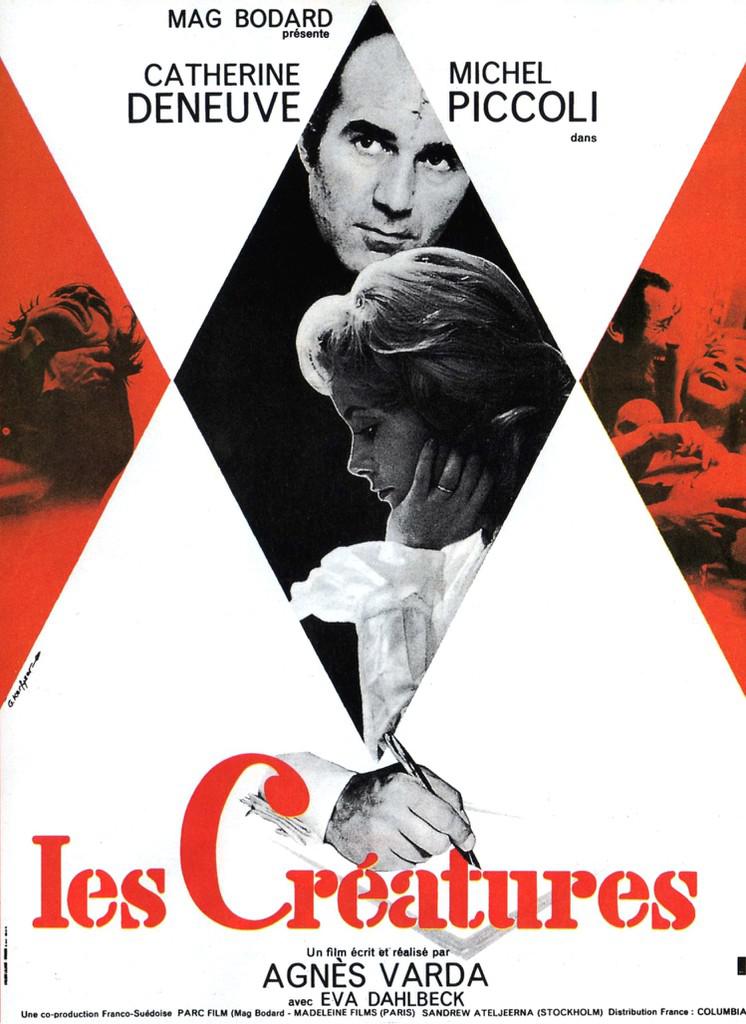
Ce film raconte une double histoire : la vie d'un couple et la naissance d'un roman. Edgar et Milène vivent comme des reclus à Noirmoutier, ils ne peuvent pas dialoguer, mais ils s'aiment, et leur amour va donner la vie à un enfant. Quant au roman d'Edgar, il naît de rien, car au hasard de ses promenades, il rencontre des personnages quotidiens, qui deviennent, les " créatures " de son roman. Les " créatures " prennent vie au cours d'une partie serrée dans laquelle Edgar défend non seulement ses convictions, mais aussi son amour.
Suzanne is 15 and is having sex with many boys, just for fun, but did not manage to really love one of them. Her family does not understand her. The father does not like her behaviour. When he leaves home, the mother becomes a little bit neurotic. And Suzanne's brother Robert, begins to beat her as a punishment...
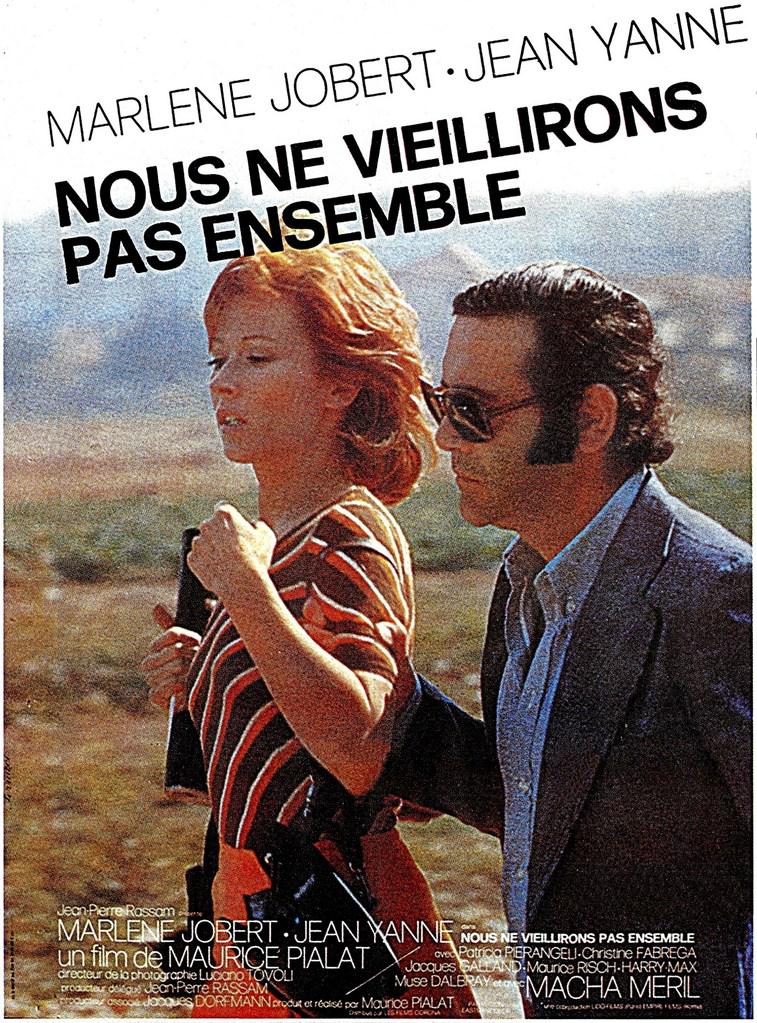
Jean, an "old teenager of forty" and failed film-maker, is married to Françoise, a woman of his own age with whom he lives, probably more out of a need for protection than out of affection. For the past six years he has had a twenty-five year old mistress, Catherine, who is very much in love with him and whom he treats with little respect, even though he is attached to her. The film is the story of the death of a couple through clashes, arguments, separations and returns. Until, fed up, Catherine decides to marry a man more socially respectable than Jean, with whom she will leave, leaving Jean desperate.
François, a student in Paris, is convalescing and returns to his childhood village. His friend Serge has become an alcoholic wreck because his wife has given birth to a Down's syndrome child. Serge is all the more unhappy and hateful because his wife is pregnant again. François wants to save Serge at all costs.
The Lelièvre family lives in a middle-class house near a Breton village. Sophie, the new maid, is efficient but a bit strange. She befriends Jeanne, the local postmistress, and the two girls break into the Lelièvre house. Their alliance becomes a wild revolt, beyond good and evil. Adapted from "A Judgment in Stone", by Ruth Rendell - 1997.
Charles is an insurance agent, he is 40 years old and leads a bourgeois life with his son and his wife Hélène. At 30, Hélène is a beautiful woman who does not work and seems to be bored in their beautiful villa. One day, Charles starts to have doubts about his wife's fidelity and hires a private detective...
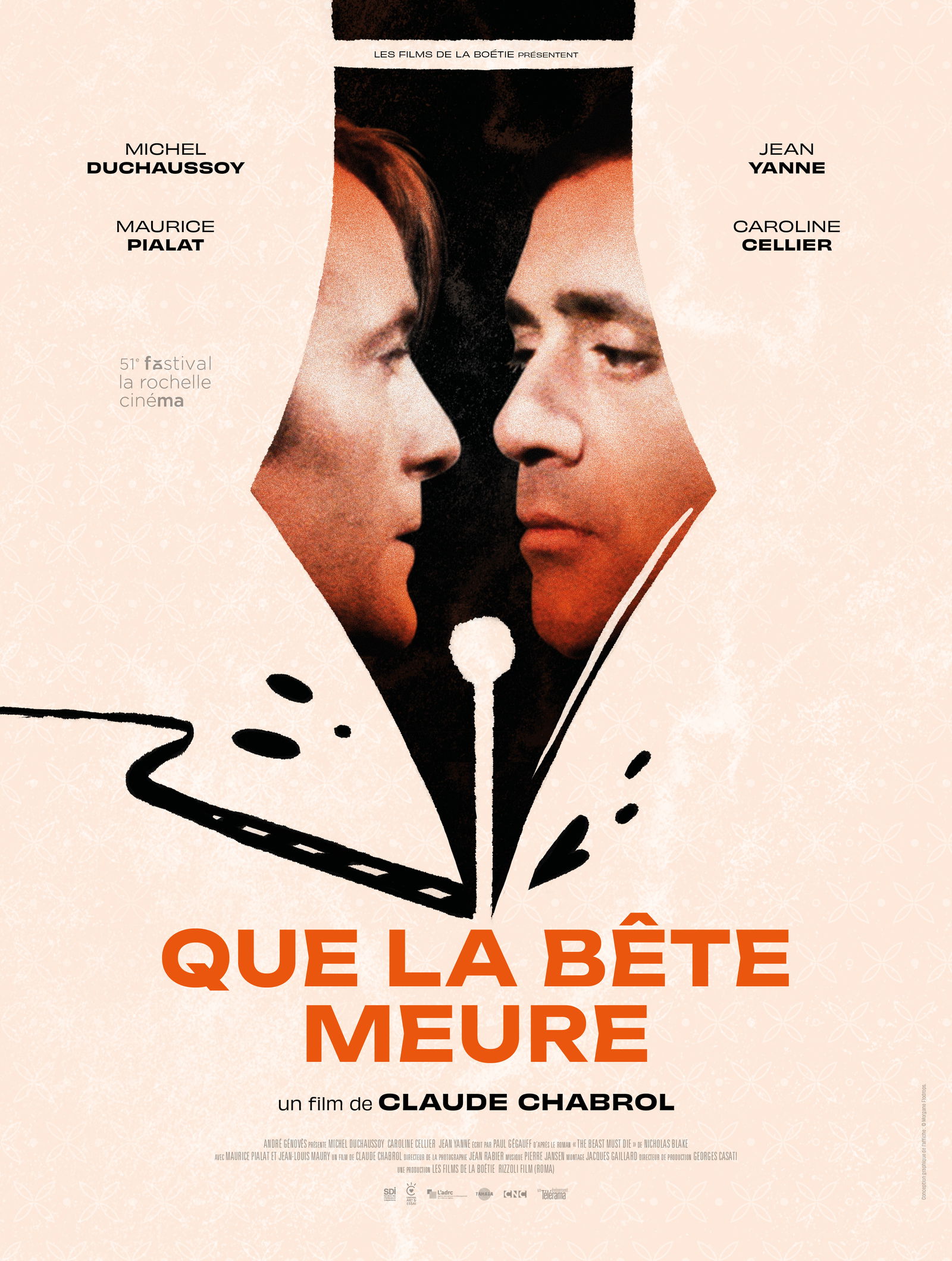
A child is killed by a hit-and-run driver on a road in Brittany. His father swears to kill the murderer, and goes hunting. Helped by chance, he identifies his prey and approaches him. A game of death foretold between two men who have nothing in common.
On the planet Perdide, in the depths of space, little Piel is pursued by a swarm of hornets who killed his father. Piel finds himself alone but Jaffar, aboard his spaceship, rushes to save him. From the ship, he will guide little Piel with the help of two extra-terrestrial clowns, Jad and Yula. He will confront the masters of time. An amazing time paradox, of an old space runner who, madly, tries to save the little boy he once was.
A mad scientist immobilizes Paris with a mysterious ray. Paris is fixed, Paris falls asleep. Only the passengers of a plane, their pilot and the guard of the Eiffel Tower remain awake, and they are going to reconquer the capital.
The third world war has broken out. The war has invaded the whole earth with its destruction and that perpetuated by radioactivity. The only way open to seek relief or a way out of this war is TIME. The flight in time, either past or future, becomes the number one problem to solve. Scientists start to work in underground shelters, where the survivors become the guinea pigs. The hero of the film will know, before his dramatic end, a moving story with a woman living in another time. Made only from still images, this philosophical tale or visionary tragedy relates life on earth after the Third World War.
Thirties, an Indian metropolis on the banks of the Ganges. Social evenings filled with foreign diplomats. A woman, or the memory of a woman, wanders among the men in their clothes. Among them, the vice-consul, falot and painful, who loves her and shouts his love in the night. Time becomes blurred, diluted in the incantatory music of the voices.
Louis, a nine-year-old boy from Paris, spends his summer vacation in a small town in Brittany. His mother Claire has lodged him with her girlfriend Marcelle and her husband Pelo while she's having her second baby. There Louis makes friends with Martine, the ten-year- old girl next door, and learns from her about life.
As the countries of the East open up to the West, Chantal Akerman sets out on a long journey from East Germany to Moscow, from late summer to the depths of winter. The film is a veritable travel diary of the filmmaker: no commentary, no exchange of words, but a succession of still shots and long traveling shots on rural and urban landscapes, punctuated by portraits of women.
Anyone who has ever ventured to the "Land of the Deafs" will have been struck by the strangeness of the choreographed signs with which deaf people express themselves. Developed ages ago, these signs constitute a veritable language. As precise and subtle as speech, they are as effective as spoken language in making a declaration love or providing a detailed technical description. Jean-Claude, Jeanine, Eric, Cyril, Alain, Juliette, Guy, Aurélien and René have one thing in common - they are all profoundly deaf. So they dream, think and communicate in sign language. Which means that they see the world differently. Viewers embark with them on a discovery of the distant land of the deaf, where sight and touch assume enormous importance. This film is a narrative documentary, recounting a story based on these characters whose lives intersect. The story is their story, and viewers see the world through their eyes...
Therese runs a café in Paris; she lost her husband when he disappeared sixteen years earlier, and, while time has healed some of her wounds, she's still a lonely person. One day, a tramp passes by humming a familiar tune, and Therese is convinced that the vagabond is her husband. She follows him to his home, a tiny shack by the river, and tries to question him about his past. She discovers that the tramp suffers from amnesia and has no clear memory of his past. Therese brings him back to her cafe in hopes of jogging his memory and renewing the love they once knew.
Une femme, un ordinateur, un interlocuteur invisible : tel est le dispositif à partir duquel Level Five se construit. La femme a "hérité" d’une tâche : terminer l’écriture d’un jeu vidéo consacré à la bataille d’Okinawa, une tragédie pratiquement inconnue en Occident, mais dont le déroulement a joué un rôle décisif dans la façon dont la deuxième guerre mondiale s’est achevée.
It's back in 52 BC. That's right, BC. Although Gaul isn’t totally overrun, Cleopatra’s Egypt is under the yoke of the Roman Empire. What’s worse is that Cleopatra, that dame with the big nose, has had the good sense to chose Caesar for her boyfriend. Caesar is the Emperor of the Greatest of All Peoples. Or so he says.
Once upon a time, two children were raised by the same nanny: Azur, blonde and blue-eyed, son of the lord of the castle, and Asmar, dark-skinned and black-eyed, the nanny’s child. Brought up like brothers, the children are suddenly torn apart. But Azur, haunted by the legend of the Fairy of the Djinn which his nanny used to tell him, intends to find her in lands beyond the seas. When they grow up, the two foster brothers each go their separate ways in search of the fairy. Daring rivals, they find magic lands in a medieval Maghreb, full of dangers and enchantments.
Champion is a melancholic little boy, adopted by his grandmother Mrs. Souza. Noticing his passion for cycling, she makes her grandson follow a relentless training. The years go by. Champion has become an ace of the small queen, so much so that he finds himself engaged as a rider in the Tour de France. But during the race, he is kidnapped by two mysterious men in black. Madame Souza and her faithful dog Bruno set out to find him. Their quest takes them across the ocean to a megalopolis called Belleville. There they meet the Triplettes of Belleville, eccentric music-hall stars of the 1930s who decide to take Madame Souza and Bruno under their wing.
In 1789, when the Revolution went on, a bandit named "Black Tulip" held the surroundings of village Roussillon in fear. The poor people respected him as Robin Hood, who declare himself a revolutioner but Count Guillaume de Saint Preux "plays" this benefactor. When he fought with Mouche, the policeman he was wounded...
In France of the late 19th century, the wife of a wealthy general, the Countess Louise, sells the earrings her husband gave her on their wedding day to pay off debts; she claims to have lost them. Her husband quickly learns of the deceit, which is the beginning of many tragic misunderstandings, all involving the earrings, the general, the countess, & her new lover, the Italian Baron Donati.
Queen Margot
Children of Paradise
Stormy Waters
Zéro de conduite
A Monkey in Winter
The Umbrellas of Cherbourg
The Earrings of Madame de...
Eyes Without a Face
Any Number Can Win
Balthazar
The Things of Life
Max and the Junkmen
Cesar and Rosalie
Vincent, François, Paul and the Others
The Story of Adele H
Small Change
Le Roi et l'oiseau
Van Gogh
The Chorus
Cosi fan tutte
Hate
Cleo from 5 to 7
One Sings, the Other Doesn't
The Creatures
To Our Loves
We Won't Grow Old Together
Le Beau Serge
A Judgment in Stone
The Unfaithful Wife
This Man Must Die
Time Masters
Paris asleep
La Jetée
India Song
The Long Path / The Grand Highway
D'Est
Le Pays des sourds
Une aussi longue absence
Level Five
Asterix and Obelix, Mission Cleopatra
Azur & Asmar
Belleville Rendez-vous
The Black Tulip
The Earrings of Madame de...
By continuing to browse this website, you agree to our use of cookies to improve your experience.Find out more